

Last updated: October 26, 2026
Quick Answer
AI college application help means using tools like ChatGPT to brainstorm, organize, and polish essays and research, but not to write the actual content for you. Enrollment counselors act as the trusted guide who teaches families where that line sits. Common App's fraud policy bars submitting AI's "substantive content or output" as your own work [1], and schools vary, so checking each school's page matters [2].
Key Takeaways
About 7 in 10 college-bound seniors have already used some AI tool during their application process [CHECK].
Common App treats AI misuse as a fraud issue, not a detection problem, it looks at "totality of the circumstances" [3].
Brainstorming, outlining, and grammar checks are generally fine; letting AI generate your actual essay content is not [4].
School policies differ a lot: Northwestern and Georgia Tech allow more; Brown and Cornell expect more caution or disclosure [2].
AI detectors are unreliable, a human reader who knows the student often notices a voice mismatch faster than software does [5].
Roughly half of admissions offices now use AI themselves for routine tasks like emails [CHECK].
Never paste private data, Social Security numbers, financial details, into any AI tool.
Enrollment professionals play four roles: Coach, Recruiter, Prompt Engineer, and the calm Key Person in the Room.
The Kitchen Table Moment Every Family Knows
A mom and her son sit at the kitchen table. A laptop glows between them. The Common App essay box is empty. He typed one question into ChatGPT an hour ago, just to get unstuck, and now neither of them is sure if that counts as cheating.
This scene happens in homes everywhere this fall. Families want AI college application help, but nobody handed them a rulebook. That's where you, the enrollment professional, come in. You're not there to police students. You're there to coach them, protect them, and keep the process honest, for the student's sake and the school's.
Think of yourself wearing four hats this admissions season: Coach, Recruiter, Prompt Engineer, and the calm person in the room when things feel confusing.
The Coach: Helping Students Keep Their Own Voice
The Coach's job is simple: make sure the essay sounds like the student, not a chatbot. Good coaching means showing families exactly where AI helps and where it takes over.
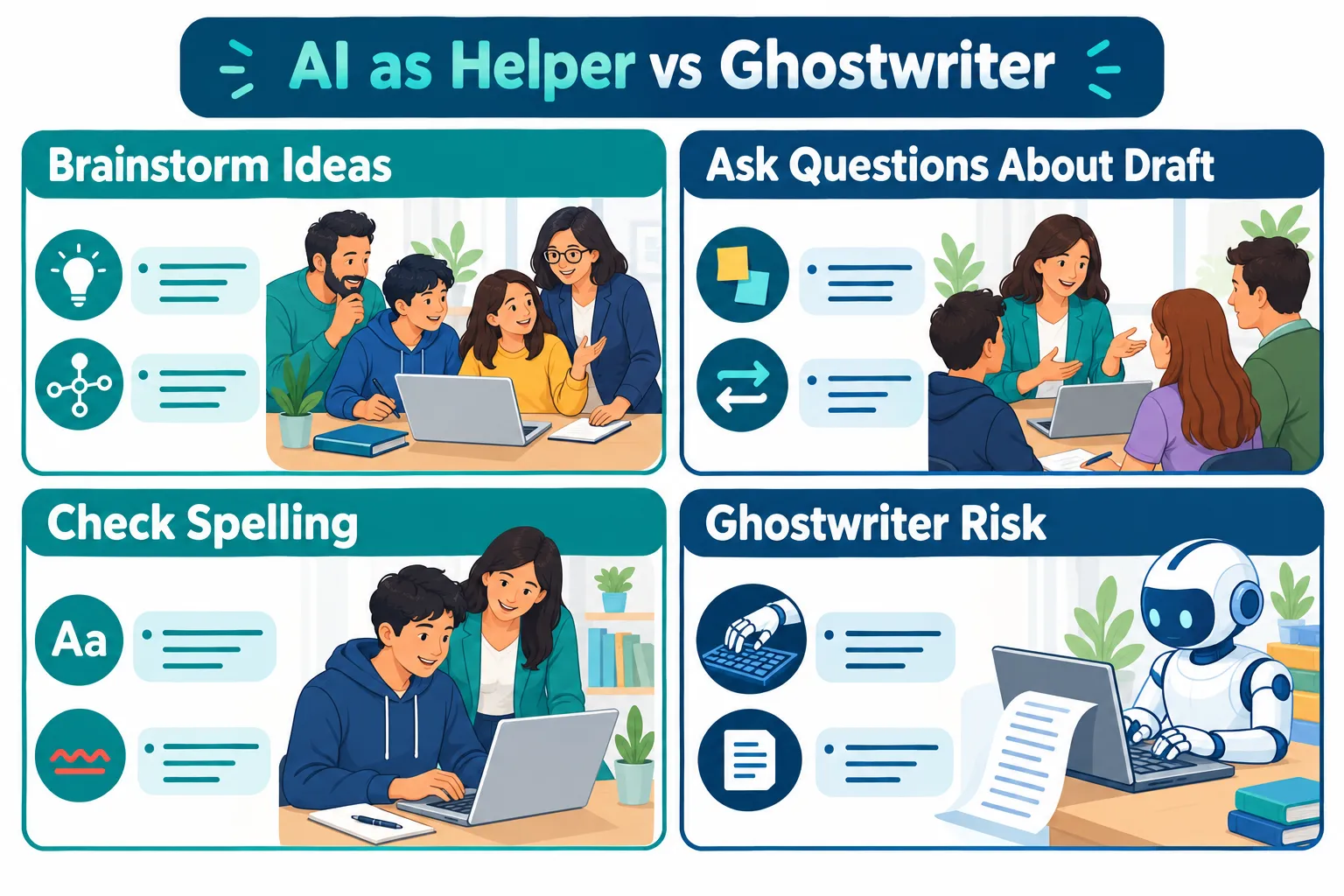
AI can be a real helper when it:
Brainstorms topics. A student asks for five possible essay angles about a summer job, then picks the one that feels true.
Asks questions about a draft. AI points out a weak paragraph and asks what the student meant, pushing them to say more.
Checks spelling and grammar. Like a spellchecker, it catches typos without changing the student's ideas.
AI becomes a ghostwriter, and a problem, when it:
Writes full paragraphs the student then pastes in as-is.
Invents experiences or details the student never actually lived.
Rewrites the whole essay's tone so it no longer sounds like a 17-year-old wrote it.
As a counselor, your review process should always ask: "Does this sound like the kid I know?" If a student's spoken voice is casual and the essay reads like a corporate memo, that's your cue to dig deeper, gently and without shame.
The Recruiter: What Schools Look For and What They Will Not Accept
The Recruiter's job is knowing the rules cold, because every school's admissions office plays by slightly different ones. Common App's baseline fraud policy bars submitting AI's "substantive content or output" as a student's own work, and that rule binds nearly every Common App member school whether or not that school posts its own separate AI page [1].
In late October 2026, Common App's Jenny Rickard reportedly said the organization judges the "totality of the circumstances", meaning intent and context matter, not just whether AI was touched at all [3]. That's a procedural approach, not an automatic scanner. Enforcement depends on reports and human review, not software flagging every essay [1].
But Common App is only the floor. Individual schools add their own layers:
Johns Hopkins allows brainstorming and basic proofreading help [CHECK].
Brown takes a stricter stance on AI involvement [CHECK].
Northwestern permits research and brainstorming uses [2].
Georgia Tech allows AI help with resumes and activity lists [2].
Wisconsin says it won't automatically disqualify a student suspected of AI use [2].
Cornell expects ethical use now and will require disclosure starting fall 2027 [2].
Your job as the Recruiter is to tell families: don't assume one rule fits every school. Check each college's own admissions page before applying, every single time.
The Prompt Engineer: Teaching Students to Ask Better Questions
A "prompt" is just the question or instruction you type into an AI tool. The Prompt Engineer's job is teaching students to write prompts that make AI think with them, not for them.
Here are five copyable prompts counselors can hand students directly:
"Ask me 5 questions about a time I solved a problem. Do not write anything for me."
Why it works: it forces AI into interview mode, pulling ideas out of the student instead of putting words in."Read my draft and tell me which paragraph feels the weakest. Explain why, but don't rewrite it."
Why it works: it keeps feedback focused on diagnosis, not replacement text."List three questions a college admissions reader might ask after reading this paragraph."
Why it works: it builds the student's awareness of their reader without handing over new sentences."Check this paragraph for spelling and grammar only. Don't change my word choices or style."
Why it works: it limits AI to a narrow, low-risk editing task, similar to spellcheck."Give me a list of topics that show problem-solving, based on these five facts about my life: [list facts]."
Why it works: it uses AI as a sorting tool, not a storyteller, since the raw facts still come from the student.
Teach students to end every session reading their essay out loud. If it doesn't sound like them talking, that's a sign AI wrote too much.
The Key Person in the Room: Honesty, Privacy, and Fact-Checking
The Key Person in the Room keeps families calm, honest, and safe while they work through tools, deadlines, and advice they can't always verify alone. This role matters because families often trust AI's answers about money and rules more than they should.
Three habits to build here:
Double-check AI answers about money, deadlines, and school rules. AI can get financial aid details or deadline dates wrong, so confirm anything important on the school's own page.
Never paste private data into AI. Social Security numbers, financial account numbers, and other private details should never go into a chat box.
Be honest about fairness. Some experts worry AI gives wealthier families an unfair edge because they have more access to premium tools. Others argue AI actually helps first-generation students who lack access to private college counseling. Both views are reasonable, and your job is to name them honestly, not pick a side for the family.
AI detectors used by some schools are unreliable, and human readers often catch tone problems faster than software [5]. That's one more reason your human judgment, as the trusted adult in the room, still matters more than any detection tool.
What Is AI College Application Help and How Does It Actually Work
AI college application help covers any way a student uses AI tools, like ChatGPT, to support, not replace, their own application work. It typically works through chat-based prompts where the student asks questions and AI responds with ideas, feedback, or corrections, while the student stays the one writing.
In practice, this looks like brainstorming sessions, draft feedback loops, and editing passes, each one still requiring the student to make final choices about words and content.
Best Free AI Tools for Writing College Essays
Several free tools can support brainstorming and essay review without writing content for students. ChatGPT's free tier remains the most commonly used option among college-bound students for brainstorming and feedback [CHECK].
Counseling platforms like Kollegio also offer structured essay review and college research tools built specifically for the admissions process, pairing AI feedback with human-style guardrails. When comparing free tools, choose one that gives feedback and questions rather than full rewritten paragraphs, that distinction keeps the student as the actual author.
Can Colleges Tell if You Used AI to Write Your Essay
Colleges can't always technically detect AI writing, since AI detectors are known to be unreliable, but human readers often notice when an essay doesn't match a student's authentic voice [5]. Admissions readers compare essays against other application materials, interviews, and recommendation letters, so mismatches in tone or detail stand out.
Common App's approach also allows for reports and investigations after submission, meaning detection isn't only about the moment of reading, it can happen later too [1][3].
How Should Parents Talk to Kids About Using AI for College Apps
Parents should talk to kids about AI college application help the same way they'd talk about any school tool: openly, without shame, and with clear boundaries set in advance. Start the conversation before the laptop opens, not after a draft is already written.
A helpful family rule: AI can ask questions and check grammar, but it can't write sentences that go straight into the essay. Revisit the school's specific policy together so the rule isn't just a family guess.
AI vs Hiring a College Counselor: Which Is Better
AI and a human college counselor serve different purposes, so most families benefit from using both rather than choosing one. AI is fast, free or low-cost, and great for organizing ideas and checking tests prep logistics; a counselor brings judgment, school knowledge, and the ability to spot tone problems AI can't catch.
Choose AI-first help if your family needs quick research on find college options or basic test prep logistics. Choose a counselor if your student needs deep essay review, interview prep, or help interpreting a specific school's admissions rules.
Common Mistakes Students Make When Using AI for Applications
The most common mistake is letting AI write full sentences that end up unchanged in a final submission, which risks violating fraud rules at nearly every Common App school [1][4]. Other frequent mistakes include trusting AI's financial aid numbers without double-checking, and pasting private information into a chat window.

A smaller but real mistake: using the same AI-written phrasing across multiple college essays, which can make essays sound identical and impersonal to admissions readers.
Is It Cheating to Use AI for College Essays
It isn't automatically cheating to use AI, but it becomes a fraud concern when a student submits AI's substantive content as their own original writing [1]. Common App's language focuses on misrepresentation, meaning brainstorming and proofreading generally sit on the safe side of the line, while full essay generation does not [4].
Students should assume that "more help" from AI means "more disclosure" is expected, especially at schools like Cornell that will require it starting fall 2027 [2].
How Do Enrollment Counselors Guide Families Through AI Tools
Enrollment counselors guide families by setting clear ground rules early, reviewing drafts for authentic voice, and pointing families toward each school's specific AI policy page. Many counseling teams now use tools that track essay review, caseload management, and feedback in one connected workspace, so nothing slips through the cracks during busy application season.
A strong review process includes checking drafts at least twice: once after brainstorming, and again after any AI-assisted edit pass, to confirm the student's voice stayed intact.
What Do College Admissions Officers Think About AI Applications
Admissions officers are still forming consistent views, but public reporting in 2026 shows most frame AI as an ethics and authorship question rather than a tool they want to ban outright [3][6][7]. Officers generally say brainstorming and research support are acceptable, while generated essay content is not [2].
Some admissions offices also use AI internally for tasks like answering emails and routine student questions, which shows the tool isn't being treated as universally off-limits [CHECK].
AI College App Tools That Actually Sound Authentic
The tools that sound most authentic are ones built around feedback and questions, not generation, since they push students to keep writing in their own words. Platforms like Kollegio pair AI-powered review with human-reviewed admissions standards, aiming for personalized learning rather than templated output.
A quick example: a tool that returns "Here's a question about your third paragraph" sounds more authentic in results than one that returns a rewritten paragraph.
How to Help Students Use AI Ethically for College Writing
Helping students use AI ethically starts with teaching them that AI should ask questions, not answer them for the essay. Pair every AI session with a rule: the student writes every sentence that goes into the final draft.
Encourage students to save their prompt history so they, and their counselor, can review how much AI involvement actually happened, a simple transparency habit that builds trust with both family and school.
Does Using AI on My Application Get You Rejected
Using AI thoughtfully, for brainstorming, questions, or grammar checks, does not automatically get a student rejected, since most schools allow that level of support [2][4]. Risk increases sharply when a student submits AI-generated content as their own, since that can trigger fraud review and consequences ranging from restricted access to notifying member colleges [1].
There's no guarantee of any specific admissions outcome either way, so families should treat ethical AI use as a risk-reduction step, not an admission promise.
Alternatives to AI for College Application Help
Alternatives to AI include working with a school counselor, a nonprofit college-access program, or a trusted teacher who knows the student's writing well. These human options can offer the same kind of feedback AI gives, questions, structure advice, without any fraud-policy risk at all.
Some families blend both: human counseling for judgment calls, AI for quick research tasks like find college comparisons or deadline tracking.
Which Students Benefit Most From AI College Application Assistance
Students who benefit most from AI college application help are often first-generation students or those without access to private counseling, since AI can fill some of that advice gap for free [CHECK]. Students who already have strong writing support may get less added value from AI, since their feedback loop is already covered.
The fairness debate runs both directions: some worry AI widens gaps for wealthier families with premium tools, while others see it as an equalizer for students without other options.
Do and Don't Box
Do:
Ask each school's own admissions page about their AI rules before applying.
Use AI to ask questions about a draft, not to write new sentences.
Read every essay out loud to check it still sounds like the student.
Keep private data, like Social Security numbers, out of any AI chat.
Don't:
Don't let AI generate full paragraphs for a final submission.
Don't assume one school's AI policy applies everywhere else.
Don't trust AI's financial aid or deadline answers without checking the source.
Don't shame a student for asking AI a brainstorming question, that part is usually fine.
FAQ
Is it cheating to use AI for college essays?
No, not automatically. AI becomes a problem under Common App's fraud policy only when a student submits AI's substantive content as their own original work [1].
Can colleges tell if you used AI to write your essay?
Sometimes, through tone mismatches human readers notice, but AI detectors themselves are unreliable [5]. Reports and reviews, not just software, drive most enforcement [3].
What do college admissions officers think about AI applications?
Most frame it as an authorship and ethics question rather than banning AI outright, generally allowing brainstorming and research while rejecting generated essay content [2][6].
Does using AI on my application get you rejected?
Thoughtful AI use for brainstorming or grammar checks does not automatically cause rejection, but submitting AI-written content as your own raises real fraud risk [1][4].
Which students benefit most from AI college application assistance?
Students without access to private counseling, including many first-generation students, often gain the most from free AI college application help [CHECK].
How should parents talk to kids about using AI for college apps?
Set clear family rules before the laptop opens: AI can ask questions and check grammar, but the student writes every sentence in the final essay.
Conclusion
Yes, AI college application help can support students this admissions season, as long as everyone understands where the line sits. Common App's fraud policy, school-specific rules, and basic family honesty all work together to keep the process fair [1][2][3]. Whether a family is just starting their college find process or polishing a final draft, the enrollment professional remains the steady guide who turns confusion into a clear plan.
One next step to take this week: sit down with your student, open one college's admissions page together, and read their actual AI policy out loud before writing another word of the essay.
References
How Does Common App Handle Fraud. appsupport.commonapp.org.
AI in College Admissions Essays. appily.com.
College Application Season Is Here So Is the Struggle to Find Out If AI Wrote Students Eessays. pasadenanow.com.
Common App AI Policy Paradox. gradpilot.com.
Do College Admissions Check for AI. fratech.net.
AI College Essays. bcscholars.com.
AI in College Admissions Essays Policies Verification 29244. academicjobs.com.